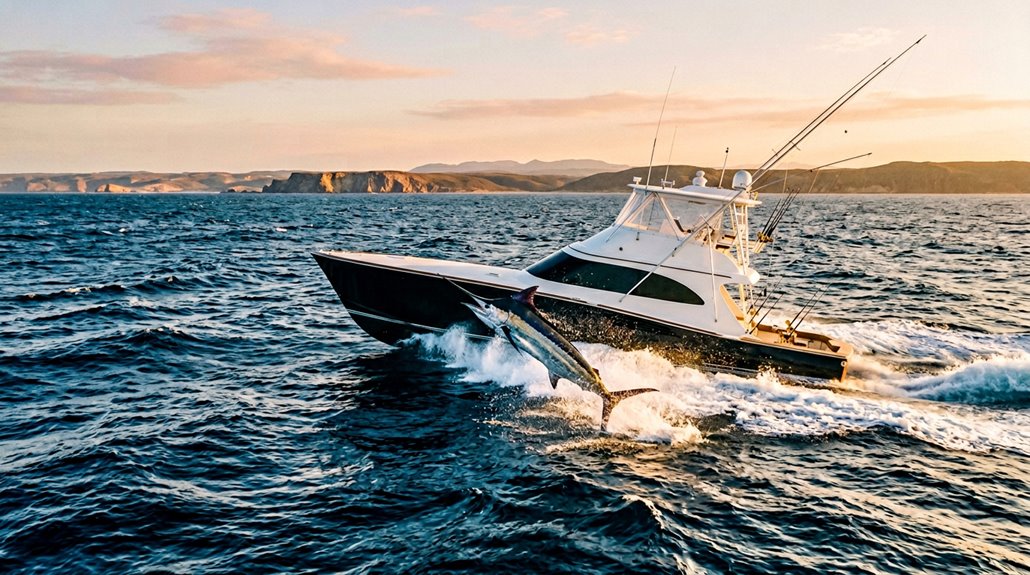
Most anglers never make it past the marina. The ones who do leave before 05:30, run up to 80 nautical miles offshore, and face marlin, tuna, and sailfish on 130 lb class tackle — heart-pounding encounters most people only watch on television. Big game ocean fishing isn’t recreational; it’s a raw, calculated pursuit demanding precise tackle, sharp instincts, and ironclad preparation. What separates a successful spread from an empty cooler comes down to decisions made long before the first line hits the water.
Picking the Right Trip: Destinations, Seasons, and Target Species for Big Game Fishing
When planning a big-game fishing trip, match destination, season, and target species to your goals. You’ll pick Cairns for black marlin (peak Sept–Dec), Key West for sailfish (Mar–Jun), and Cabo for marlin and dorado (May–Nov). Bermuda gives year-round wahoo and yellowfin, with marlin May–Nov. Panama’s Hannibal Bank targets tuna and marlin. Different ocean regions influence what species you’ll encounter and where to go. “You should prioritise local fish runs and ocean conditions.” Short offshore runs reduce transit time, often 3–20 miles. Reef edges and banks concentrate pelagics. Season windows: marlin Sept–Dec (Cairns), Mar–Jun (sailfish), May–Nov (Bermuda/Cabo). Species diversity matters for efficiency. Consider big game fishing South Africa as part of broader planning, if you want combined land and sea options managed by experienced outfitters. KwaZulu-Natal’s coastline offers access to highly productive waters where powerful pelagic species like marlin and yellowfin tuna are actively targeted by dedicated charter crews.
Gear and Boat Setup You’ll Need for Dorado, Sailfish, Tuna, and Wahoo
You’ll need the right rods and reels, with dorado setups at 6–7 ft medium-action and 30–50 lb line, sailfish on conventional trolling outfits with high-capacity reels, and tuna/wahoo on medium-weight conventional gear built for speed and repeated strikes.
For trolling and baiting, use skirted lures, feathers, and live baits (ballyhoo, menhaden, cigar minnows), rig leaders at 30–40 lb for dorado and wire leaders for wahoo, and keep 100 yards of braid with about 100 yd mono top-shot for casting near structure. Dorado are often attracted to floating debris that concentrates baitfish, so check around weed lines and debris when casting or trolling.
Safety and boat gear must include reliable life jackets, an outrigging system or spread control, a smooth-drag winch or lever drag reel, and clear emergency communications (VHF, EPIRB), so you’ll be prepared and get consistent, professional results.
Rods And Reels
Pick gear that matches target species and boat work, and set it up for strength and corrosion resistance. You’ll want gear that supports your ocean fishing experience and team. Choose 6.5–7.5 ft rods for sailfish for mechanical advantage and jumps. Use 6–7 ft trolling rods for close-quarters boat handling. Prefer medium-light to medium-heavy power for sailfish and 20–30 lb class stout rods for general pelagics. Sailfish are prized for their speed and acrobatic displays, often reaching speeds up to 68 mph.
“Reels and drag”
- Conventional trolling reels for heavy loads.
- Spinning reels size 5,000–8,000 for lighter versatility.
- 30W–50W class reels for tuna and wahoo.
- Gear ratio 6:1+ for fast retrieval.
- Strong, adjustable drag systems.
“Line and leaders”
- Braid 30–60 lb for main line.
- Mono 20–30 lb for top shots.
- Wire leaders for wahoo.
Trolling And Baiting
Rods and reels set the foundation, but trolling and baiting determine how fish find your offering and how effectively your crew manages the spread. You’ll run short corners with big, noisy lures, long corners and outriggers with medium flashers, and shotgun lines with small quiet lures far back. Use plugs, rigged ballyhoo, and strips for offshore dorado fishing, wahoo, and tuna. Dorado are fast-growing and frequently hungry, so they’ll aggressively take offerings when present; they also often associate with floating debris.
| Position | Lure/Bait | Distance |
|---|---|---|
| Short corner | Big splash plug | 30–50 ft |
| Long corner | Medium flasher | 75–150 ft |
| Shotgun | Small lure | 200–350 ft |
| Centre | Rigged ballyhoo | 50–200 ft |
Watch tracking, adjust speed (6.8–12 kn), keep baits in seawater, and rig ballyhoo through gill to throat for reliable hookup. For those looking to extend their adventure beyond the water, custom ocean and safari packages allow anglers to combine deep-sea fishing with guided wildlife experiences across diverse African terrain.
Safety And Boat Gear
Safety is non-negotiable on offshore charters, and your boat gear must match the species and conditions you’ll face. You’ll carry Coast Guard-approved life jackets for every person, plus a throwable flotation device. Use offshore/heavy-weather vests with signal-light clips and bright colours for visibility.
“Emergency signalling and location devices are essential.”
- EPIRB that activates manually or automatically.
- Marine VHF-FM radio; mobile phones are unreliable offshore.
- Three daytime and three nighttime flares or approved signal light.
- Carry a registered personal locator beacon as an additional portable distress transmitter.
“Fire, power, and mechanical backups reduce risk.”
- B-I extinguisher for 16–26 ft boats; B-II or two B-I for 27–40 ft.
- Spare belts, hoses, impellers, extra fuel, charged battery, working GPS.
File a float plan, carry two anchors with 200 ft rope, and consider a life raft. Just as expert teams manage safari logistics SA to ensure organised and stress-free arrivals, coordinating your offshore safety systems in advance keeps every charter departure smooth and well-prepared. south african marine charters recommend these standards.
A Day Offshore: From Pre-Dawn Launch to Trolling, Live Baiting, and Kite Setups
Before dawn you’ll be boarding for a 6:00 a.m. departure, which is standard for deep-sea charters and gets you to productive grounds well before sunrise.
You’ll join seasoned sailfish charters South Africa teams, and feel part of a focused crew.
Trips run 8–12 hours, often with a 2–2.75 hour run to grounds 15+ miles offshore.
Trolling spreads use 2–6 rods, outriggers, and weighted lines to cover depth and distance.
Live baiting presents struggling bait away from the boat, triggering strikes on marlin, tuna, and sailfish.
Kite setups hold live bait on the surface, increase visibility, and allow lighter tackle (20–30 lb common, 8–12 lb possible).
“You’ll fish until about 14:00–14:30,” the captain notes.
Charter gear, ice, and fillet service are provided.
Reading the Ocean: Where Pelagic Fish Congregate and How to Find Bite Zones
After you pull lines and inspect spreads, you’ll start reading the sea for bite zones. You look for intersections of food, structure, and current margins. Pelagic fish South Africa often gather at current edges, seamounts, and upwelling zones. Temperature structure matters; thermoclines concentrate bait and predators.
“You’ll watch water colour, turbidity, and floating structure,” you tell the team. Slightly turbid water (Secchi 15–35 m) signals higher productivity. Floating sargassum, flotsam, and weed lines act as aggregation points. Depth matters; species occupy layers defined by temperature, salinity, and oxygen. Much like ranger-led open vehicle drives tailor routes to maximise wildlife sightings in the bush, experienced captains tailor their ocean routes to maximise encounters at productive bite zones.
Bulleted cues:
- Current edges and fronts
- Islands, seamounts, and slope upwellings
- Secchi 15–35 m
- Floating debris and weed lines
You act on these signals.
Fight Tactics and Teamwork: Landing a Run, Multiple Hookups, and Crew Roles
When a big fish runs, you brace the rod butt against your hip or the rail and use your legs and torso to apply steady leverage, not just arm strength. You keep a low, stable stance, short pump-and-reel cycles, and side pressure to turn the fish. Drag is progressive; avoid sudden lockdowns that risk line failure. Maintain constant tension and ease briefly if the fish jumps. The captain aligns the boat; you move with the fish to keep angle. For multiple hookups, separate lines and space crew 2–3 m apart. Communicate concise commands for drag, direction, and recovery.
| Role | Action | Spec |
|---|---|---|
| Angler | Leverage, 15–30 s pumps | Rod angle 10–30° |
| Captain | Boat positioning | 2–5 kn drift |
| Crew | Line management | 2–3 m spacing |
Safety, Handling, and Trophy Decisions: Gaffing, Release Protocols, and Post-Catch Care
Landing a big fish is only the start; handling choices determine safety, legal compliance, and meat quality. You wear a U.S. Coast Guard life jacket, carry a first-aid kit and VHF radio, and monitor weather constantly. For wahoo fishing kzn, keep deck clear and use non-slip footwear.
Wet hands before touching fish and limit air exposure to under 10 seconds when possible. Support the fish horizontally if lifted.
- Use a gaff only at the rail when fish is boat-side, one secure strike, avoid repeated jabs.
- Use pliers, dehookers, or lip grippers to remove hooks quickly; cut line near deeply set hooks.
- Chill harvested fish below 40°F, shade and ice immediately, transport in insulated boxes.
“Follow local size and bag limits.”
For anglers who harvest trophy-worthy catches, professional field preparation and taxidermy services can manage the entire process from skinning to final mount delivery, removing the burden of logistics and paperwork entirely.