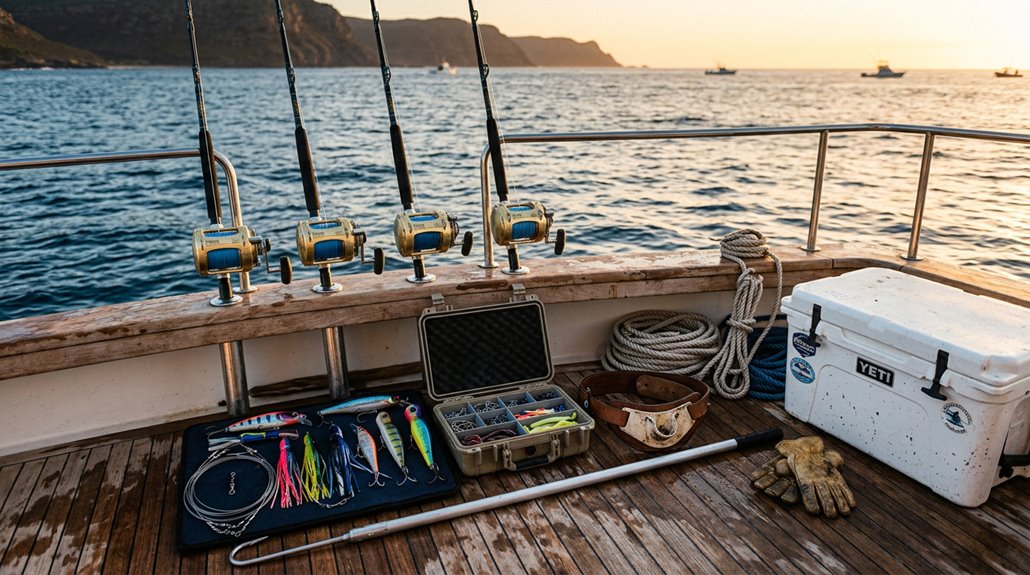
Most anglers think deep sea fishing success comes down to luck — it doesn’t. On a recent Indian Ocean expedition, a single 7-ft rod and 6,000-class spinning reel pulled in a staggering 120-lb yellowfin tuna. The right tackle made that possible, and the wrong tackle would have cost everything. From braid ratings to fluorocarbon leaders, every piece of gear has a purpose. What you bring onto that boat will either land the fish or lose it.
Pick the Right Rod and Reel Setup for Indian Ocean Deep-Sea Fishing
Choose gear that matches the fish and the method. You’ll select a compatible rod and reel for Indian Ocean deep-sea work. Use sturdy 7-foot rods for general offshore casting and trolling. Match action to technique: casting, drifting, or vertical work.
Choose sturdy 7-foot rods and matching reels for Indian Ocean deep-sea work; match rod action to casting, drifting, or vertical techniques.
“Reel choice must reflect the presentation and target species.” Prefer spinning reels in 6,000–8,000 series for distance and ease. Use conventional star or lever drag reels for wrecks and vertical drops. Ensure reels hold 250 m of 15 kg (30 lb) line or more for larger fish. For heavier targets like mulloway or sharks, consider a dedicated heavy outfit with a rod rated 12–20 kg and a large-capacity reel. Charters targeting massive pelagic species such as Marlin and yellowfin Tuna require the heaviest line classes and a fighting chair setup to manage the physical demands of the fight.
- Rod rating: 12–20 line class for medium fish.
- Offshore example: 30–60 lb class for big game.
- Maintenance: rinse with fresh water after use.
Line Choices Explained: Braided vs Monofilament and Recommended Ratings
You’ll prefer braided line when you need maximum strength and sensitivity because braid has a much smaller diameter for a given breaking strain and near-zero stretch.
Use braid in heavy cover or for long casts, with recommended ratings from about 10 lb for open flats up to 25–40 lb around mangroves and structure.
For general rough-ground saltwater work, stick with 25–30 lb monofilament, which offers useful stretch as a shock absorber and lower underwater visibility.
Braided Line Advantages
Braided line gives you high tensile strength in a slim profile, making it ideal for deep-sea work where power and sensitivity matter. You’ll choose braided fishing line for low stretch, direct pressure transfer, and improved bite detection. It supports hard hooksets and long runs from large fish. Modern braid offers greater flexibility than original braided materials, and is typically made of dacron or similar fibres braided into multiple strands.
| Feature | Benefit | Example |
|---|---|---|
| Strength-to-diameter | More line on spool | 30 lb braid ≈ thinner than 30 lb mono |
| Sensitivity | Feel subtle bites at depth | Detect bottom contact quickly |
| Durability | Better abrasion and UV resistance | Longer reel life, less respooling |
“Use braid for mainline around structure.” Match rating to species, reel capacity, and drag, not just highest pound-test.
Monofilament Ratings
Monofilament line ratings usually indicate the normal breaking strength for a properly adjusted reel and drag, and they help match line diameter to a rod’s action. You’ll use monofilament fishing line ratings to pick line that fits the rod’s mono-rating, not just raw pound-test. Rods labelled 8–12 lb expect that range for proper casting and bend.
“Use braid by equivalent diameter when substituting; 10–20 lb mono often matches 15–30 lb braid.”
- Monofilament: single-strand nylon, stretches, often floats.
- Braid: woven polyethylene, smaller diameter for same strength.
- Practical rule: match diameter and drag settings.
- Check reel capacity charts.
You’ll be delighted with reliable, coordinated rod, reel, and line choices. When targeting species like marlin and giant tuna, pairing your setup with premium tackle selection and experienced guidance can significantly improve your success on the water. When matching line to the rod, remember that power ratings indicate the rod’s leverage and should guide line choice to avoid stressing the blank, so use the rod’s power rating as a primary reference.
Terminal Tackle You Must Have: Hooks, Swivels, Weights, and Leaders
Start with the right hooks, swivels, weights, and leaders to build a rig that’ll hold up in offshore conditions. You’ll need deep sea terminal tackle choices that match target species and bait size. Use Mustad 7691 DT 8/0 for medium ballyhoo, 7692 DT 10/0 for larger baits, and 7698 2X for bluefin. Choose heavy-duty styles for big fish.
“Swivels reduce twist and connect line sections.” Use a 380 lb wind-on swivel with 175 lb fluorocarbon leader, or a 310 lb barrel swivel with 150 lb mono. Snap swivels help on spreader bars.
Weights control presentation. Chin weights pair with chafe gear and crimps. Protect all connections; size crimps correctly and use hollow-core braid splices where needed. For offshore trolling and kite setups, consider using spreader bars to present multiple baits at controlled distances.
Lures, Baits, and Rigs That Work in the Indian Ocean
Choose lures and rigs that match target species, depth, and local forage. You’ll use Indian Ocean fishing gear that favours heavy jigs for deep trolling, soft plastic jigs that mimic squid, and bucktail jigs with bullet-style heads for faster sink rates. Tipping jigs with cut or live bait adds scent and raises hookup odds.
“Use a solid-tie mooching rig with twin hooks for tight spin on herring or anchovy.” Close the mouth with a dental rubber band to preserve rotation. Reverse-bend anchovies create strong roll.
For bottom work, employ three-way swivel rigs, Hi-Lo rigs, and fishfinder slide rigs. Use pyramid sinkers for surf-style holding. Keep bait natural, suspended in the strike zone, and match local baitfish species for best results. If you’re travelling internationally with your gear, working with experts who manage hunting firearm regulations and permit documentation can prevent costly delays at customs upon arrival.
Essential Tools, Deck Gear, and Safety Items to Bring
You’ll want a compact kit of essential deck tools, including long-nose pliers, braid scissors, a basic 10-piece tool set (screwdrivers, adjustable spanner, pliers), and a waterproof tackle bag to keep them dry.
Bring safety gear: a properly fitted USCG-approved life jacket/PFD for each person, non-slip deck shoes, broad-spectrum SPF 50+ sunscreen, polarised sunglasses, and a waterproof VHF or a phone in a dry case.
For fish handling, pack a lip-gripper or dehooker, heavy-duty gloves, a gaff or landing net rated for the species (200–400 lb capacity for large pelagics), and a measuring ruler to verify legal sizes.
Essential Deck Tools
On a deep-sea charter you need the right deck tools to work quickly and stay safe. You’ll pack deep sea fishing tackle in an organised system, so you can change rigs in under two minutes. Use waterproof storage for electronics and licences, and reserve at least one cooler for catch and food.
Pliers, braid scissors, and a hook remover cover 90% of deck repairs and unhooks.
- Tackle organisation: large tackle box, side pouches, sinker trays, labelled compartments.
- Fish handling: landing net, gaff (rated for 50–150 lb fish), lip gripper, quick-release tools.
- Rigging spares: circle hooks (sizes 4/0–8/0), fluorocarbon leaders (30–200 lb), spare swivels and braided line.
“Pack these, and deck work stays efficient.”
Safety Gear Essentials
After you’ve organised rigs and deck tools, make safety gear your next priority. You’ll need a Type II PFD for each person on boats 16–40 ft, plus offshore/heavy-weather PFDs for rough water. Carry one throwable flotation device for that size range. Keep whistles, mirrors, and personal signal devices ready and attached to jackets.
“Carry three daytime and three nighttime visual distress signals or an approved alternative signal light and distress flag,” per Coast Guard guidance. Bring an EPIRB and a PLB for redundancy. Use a VHF-FM marine radio and a handheld backup. Install GPS/chart plotter for course guidance.
Pack a sealed first aid kit, bandages, antiseptics, seasickness meds, and gloves. Monitor weather continuously. Use wire leaders fishing when toothy species are expected.
Fish-Handling Equipment
- Deck control: gaff (use sparingly), lip gripper, fish cradle; measure with a board to 1 cm accuracy.
- Sanitation: cooler with ice slurry, rinse hose, disposable gloves; target <4°C core within 2 hours.
- Tools: heavy-duty pliers, crimping tool, line cutters; organise swivels and hooks.
What Charters Supply and What You Should Pack Yourself
When you book a deep-sea charter, confirm exactly what the operator supplies so you know what to pack. kzn fishing charters often include a captain and mate, fuel, rods and reels, terminal tackle, bait, ice, and fishing licences. Dockside fish cleaning is frequently covered.
What charters may not include
- Food and drinks: often excluded; some provide lunch.
- Gratuities: usually extra (standard 15–20%).
- Speciality lures: may cost extra.
- Fish shipping and taxidermy: commonly excluded.
- Add-on fees: live bait or extra fuel possible.
What you should pack
- Sunscreen, hat, polarised sunglasses.
- Enough prescription medicine for the trip.
- Cash for tips and dock fees.
- Waterproof bag, non-slip shoes, light rain gear.
If you plan to keep a prized catch, arrange trophy field preparation and taxidermy services independently, as reputable providers handle everything from skinning and cleaning in the field through to final shipping and home delivery of finished mounts.