Most taxidermists won’t tell you this: the pose you choose matters far more than the mount itself. A breathtaking kudu can look painfully awkward if the head turn fights your display space, or if the viewing angle was never considered. Get it right, and your piece commands the room. Get it wrong, and no amount of craftsmanship saves it. Before you commit to anything, there are critical measurements, reference photos, and display considerations that separate a stunning result from an expensive regret.
Quick Recommendations: Choosing the Right Taxidermy Pose
When selecting a taxidermy pose, prioritise the species’ shape. Focus on defining lines, horn sweep, and shoulder mass. Choosing taxidermy poses means matching the pose to the anatomy, not the trend. “Linear species benefit from a turn,” which shows horn length and vertical markings.
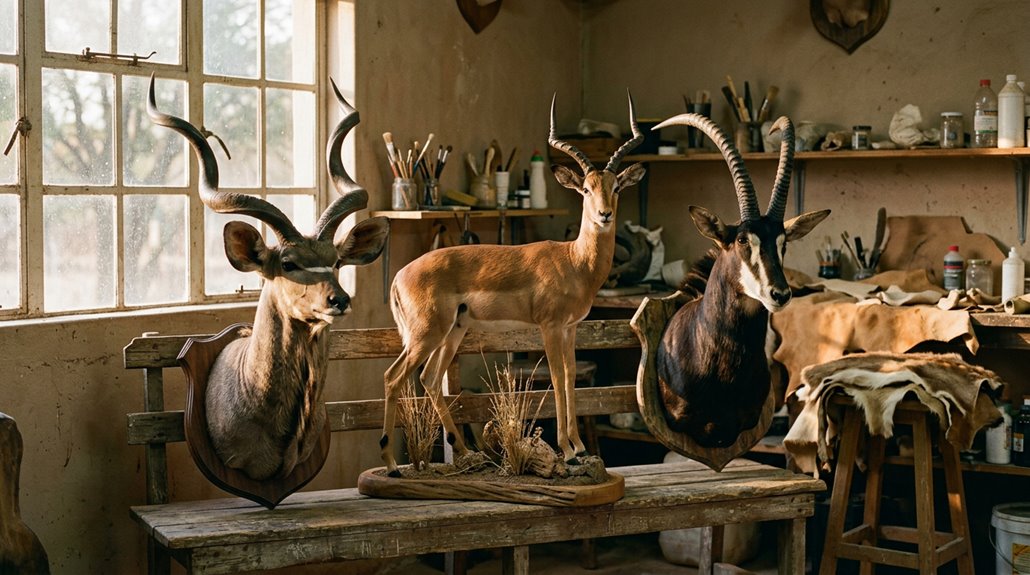
You’ll prefer African shoulder mounts when wall space is limited; they project 10–20 cm for depth and preserve the horn silhouette. Kudu often suit a straight or slight turn; gemsbok need a more angled display to avoid lost markings. Use a 15–30° head turn for an improved profile on long-horned animals. Consider mount projection, room width, and viewing height. Expect professional taxidermists to advise based on species, space, and desired visual impact. A dedicated team can manage the entire process from field preparation to shipping, ensuring your trophy arrives in perfect condition. Gemsbok, in particular, are best displayed slightly turned to highlight their horn length.
Comparing the Look: Shoulder Mounts vs. Pedestals vs. Full-Size vs. European Skulls
You’ve already thought about pose and anatomy; now compare how different mount types change the visual result. You’ll choose based on realism, space, and budget.
Shoulder mounts offer lifelike presentation, showing head, neck, and shoulders on a form. They require ~0.6–1.0 m wall height and cost more than skull options. Shoulder mounts require occasional maintenance to preserve hide and features.
Shoulder mounts give a lifelike head-and-shoulders display, needing about 0.6–1.0 m wall height and costing more than skulls
“Pedestal mount taxidermy” projects into the room, uses a stand or habitat base, and balances size with impact.
Full-size mounts recreate the whole animal, need large floor area (2–6 m²), and involve the most labour. Many hunters pursuing plains game hunting across South African concessions find full-size mounts to be the most rewarding way to commemorate diverse species taken in the field.
“European skull mounts” present a minimalist, bone-focused look, save space, and often cost less (examples: £80–£150 for skull cleaning).
Choose by desired visual hierarchy: full-size or shoulder for realism, pedestal for drama, European skull mounts for compact displays.
Room Layout, Sightlines, and Head Turn: How Space Decides the Best Pose
Because room size and sightlines determine what viewers actually see, pick a mount and pose that match the space. You’ll favour shoulder mounts for limited wall depth. You’ll choose pedestals or full-size taxidermy mounts when viewers can walk around. Measure floor clearance and circulation before committing.
- Decide sightline: a 23° (¼ turn) shows shoulder and horn form; 45° (½ turn) gives stronger side gaze; 135°–180° shifts attention across the room.
- Match mount type: wall pedestals add offset with minimal floor use; stacked pedestals need large footprints; lifesize displays need both space and budget.
- Refine head turn to face open room, preserving horn length when mounted lower. Local taxidermists often recommend mounting choices based on authentic anatomy. Professional outfitters offering field preparation services ensure the trophy arrives in optimal condition, directly influencing which poses and expressions a taxidermist can realistically achieve.
Species-Focused Poses: Showcasing Kudu, Gemsbok, Nyala, and Warthog Features
For kudu, gemsbok, nyala, and warthog mounts, choose poses that highlight each species’ defining features and suit your display dimensions. Opt for shoulder or wall-pedestal mounts for kudu to showcase stripe patterns and horn sweep. Full pedestal or life-size mounts work well when the floor area exceeds 2.5 m² and you want a statement piece. Gemsbok benefit from straight or slight-turn shoulder poses to emphasise horn shape; a pedestal depth of 60–90 cm enhances the silhouette impact. Nyala require slight-angle mounts to reveal striping, mane, and body contour; wall-pedestal mounts expose more of the hide. Warthog shows best in a low, alert stance that maintains a natural profile. Use South African taxidermy options and African taxidermy reference photos to confirm proportions, measurements, and final appearance. Decide the final display location before visiting your taxidermist so they know which way to turn the mount know where the buck will live. When planning your hunt, coordinate firearm import documentation well in advance so your rifles clear customs without delays and your trophy collection can begin on schedule.
Planning Height, Expression, and Reference Photos: Communicating Your Vision to the Taxidermist
After you select the species and pose, plan the mount’s viewing height and facial expression with the same care you used for silhouette and placement. You’ll set camera eye-level at 1.5–1.7 m for shoulder-height species to avoid distortion. Step back and use an 85–200 mm equivalent focal length. This helps safari taxidermy services deliver accurate proportions.
“Expression drives realism.” Supply photos showing eyes, muzzle, ears, and exact head angle. Natural, unforced looks replicate living detail. Provide multiple angles and lighting notes. Make sure your photographer understands to step back and zoom when capturing reference images. Ranger-led open vehicle drives offer ideal conditions for gathering close-up reference shots of wildlife in their natural habitat.
- Take 8–12 sharp, full-frame images.
- Include at least 3 close-ups (eyes, muzzle, ears).
- Note intended display height and left/right orientation.
Organise files, add measurements in cm, and a brief written intent. This aids preserving hunting memories and yields a predictable, great result.